Wednesday, August 22, 2012

Ramy's 2012 soaring safari


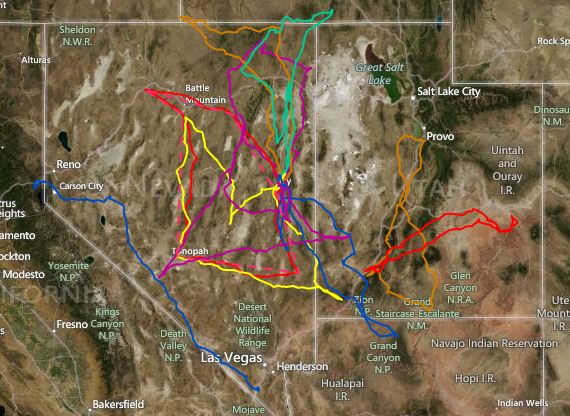
Flight traces from 3 weeks soaring safari to Ely, Parowan and Jean, spanning 6 states (California, Nevada, Utah, Idaho, Oregon, Arizona) and areas such as Lake Tahoe, Death Valley, Las Vegas, Great Basin National Park, Grand Canyon, Zion Canyon, Cedar Breaks, Escalante, Lake Powell, Canyonlands, Arches National Park (Moab). Total distance flown 5878 miles (9405km). Total flying time 81 hours in 10 flights (averaging 940km and 8 hours per flight).
Out of the 10 flights, 5 were between 1000-1250km, including 2 flights over 1000km FAI triangle and one declared 3TP 1000km which  earned me my 1000km diploma.
Below are some photos and a video clip:

Zion Canyon, UT

Zion Canyon, UT

Zion Canyon, UT

Grand Canyon North Area

Grand Canyon North Area

CanyonLands

Moab/Arches National Park

Canyonlands

Monday, August 13, 2012

Shamin's double Truckee adventure (first flight in 'new' aircraft to Truckee + first N81C soaring flight from Truckee)

On Saturday (11th) I flew N8579 to Truckee for a day of soaring. This
would be my first day of "real" Truckee soaring, after Larry checked
me out two weeks ago.

The day in San Francisco was clear and sunny. I planned an 8:30 take
off and 1:45 enroute, but driving down the peninsula towards San
Carlos I could see a fog bank to the south. It looked shallow -- tops
around 2500. Sure enough, KSQL was firmly in the fog, with the ATIS
saying 600 overcast.

KSQL is on the shore of San Francisco Bay. The CA/NV high-resolution
satellite image Buzz had posted (*) showed that the fog was confined
to the bay, and Sunol Pass was clear. If I could get out, I could
climb above the fog before crossing the bay. Finally at 9:30 the fog
had retreated a few miles south of the airport (but Sunol Pass was
still not visible), so I fired up the engine and asked for a
southbound departure. "The field is IFR, say intentions." Surely
you're joking! The sky was clear and blue and the sun was shining.
"Ok, request Special VFR." When I got to the run-up area, "579, a new
ATIS will be coming out and conditions will be VFR. Do you still want
that Special?" Sometimes I just don't understand controllers.

The Class B floor was at 4000 above. The Citabria was climbing better
than 1000 fpm so I was at 3500 well before Palo Alto. The tops were at
2000 but I had to continue south to Stanford Stadium before turning
left, to pass directly over KPAO: Class B to the left of me and Class
C to the right of me. Then a step climb under the Class B to 9500, my
final altitude. The rest of the flight was just scenery viewing and I
landed at KTRK at 11:15. After I parked the airplane I realised why it
had been hard to taxi in -- the tailwheel was flat. NOOOOooooo!

Time to worry about that later, now's the time for soaring. I got 81C
ready, and after waiting a bit for all the contest gliders to go, I
launched at 1:00. Applying a principle from Thermal Camp, I had
decided that above 8400, I would pull the release if I saw 10 kt for
more than 2 seconds. At 8200 the needle pegged: close enough! By the
time I released we were already at 8300. I continued climbing in a
right turn; it took concentration to stay in the lift and to try to
center it. (I remembered at Thermal Camp the instructors and some
experienced pilots saying thermalling is the time to relax, eat a
sandwich, and look at the chart. Ha!)

I got up to about 12k before I fell out for good, or it died, or
something. Oh well, time to go hunting for more. I headed for the bare
rocks near Frog Pond and after some fierce sink, connected with a nice
8 kt. Staying in lift was much easier higher up, and I remembered
reading that too. Soon I was passing 12.5k so I started the 30 minute
countdown. O for a working oxygen system! Pretty soon I was at 14k,
time to leave the thermal and fly around for a bit taking pictures.
There was some very impressive looking overdevelopment over the Carson
Valley. After I got back to 12k it was time to go searching... and up
we go again! It was much stronger that time, and I could see a Cu
forming above providing some nice shade. At 14k I had to open the
airbrakes and push, but the lift seemed endless.

Finally it was 1:45 and my 30-minutes were up, so I popped the brakes
and went back down. I flew around at 10k for a while, and everything
was going up. Damn, I'd promised Kit I'd land by 2:30 so he could get
some flying in too. I finally found some sink and circled down, and
was on the ground at 2:15.

Now back to the flat tyre... The folks at Soar Truckee were very
helpful. The Citabria and Pawnee use the same size tailwheel so they
were hopeful, but alas, they didn't have any spare tubes. A very
helpful gentleman named Bill Shields even carted the compressed air to
inflate the tyre just in case it was a slow leak, and then took me
over to the FBO on the other side of the airport to see if they had
any tubes. After that I started calling around at all the FBOs in the
area, and finally, SoaringNV happened to have a tyre and tube of the
right size! Luckily my girlfriend had driven up (she isn't ready to
ride in a small plane yet), so the next morning we took a little
road-trip to Minden. There I happened to run into Mike Schneider, who
commiserated and welcomed me to the joys of airplane ownership. He
also told me about the fierce thunderstorms of the previous day.

Then back to Soar Truckee, where Bill Shields taught me how to change
the tailwheel tyre and tube as he did it. He used to own a Citabria
some years ago, and told me about things to look out for. I then spent
a little time helping out on the line, and then back in the air for
the quick 2:00 flight home at a stately 90 kt.

Thank you Soar Truckee and Soaring NV, and special thanks to Bill Shields!


* High-res CA-NV satellite image -- Buzz posted this link to the list
a few months ago:
http://www.nrlmry.navy.mil/sat-bin/display10.cgi?SIZE=full&PHOT=yes&AREA=pacific/eastern/sierra&PROD=vis&TYPE=ssmi&NAV=epac_westcoast&DISPLAY=Latest&ARCHIVE=Latest&CGI=epac_westcoast.cgi&CURRENT=20120811.1415.goes15.vis.x.sierra.x.jpg&MOSAIC_SCALE=15

Friday, August 3, 2012

Maja's first 5 hr solo “endurance” flight from Minden - last hour was hard work! CONGRATULATIONS!

http://www.onlinecontest.org/olc-2.0/gliding/flightinfo.html?dsId=2610912

My first 5 hr solo "endurance" flight from Minden
The initial plan for Saturday, July 28 2012 was to get used to longer
solo flights along the Pine Nuts and around Minden Valley. However, the
soaring forecast was better than expected, with predicted ceilings at
17.300ft and lift in excess of 10kts. Particularly good forecast was for
south of Minden, along the Sierras. Around 11 am, a lot of pilots were
getting their gliders ready and staged them at the apron of rwy 30, like
birds on a wire waiting for the signal that the lift is good over the
Pine Nuts which then they use to jump further south. I spent most of the
morning with folks from Soaring NV and Mike S, figuring out which
official IGC recorder to use in case I have something to claim at the
end of the day. After multiple tests, we settled on the Cambridge
GPS-NAV that is already in KP, our G103 that is flying out of Minden
during the summer.
I was getting ready to launch around 1pm, and Mike S who had agreed
to be my official observer, said "See you after 6pm!" The tow towards
the Pine Nuts was 7min, and I released at 2900ft AGL. On tow, we were
mostly going through the sink in the valley - even Mineral Peak, a hill
in front of the Pine Nuts, looked high. But, there was one promising
thermal, and once I got off, it took me up to 12,500ft right away;
hopped to another one also around 12,000ft but closer to the ridge, and
that felt like a comfortable altitude and proximity to jump to Pine Nuts
and search for some stronger lift. It was mostly blue until now, but
little clouds starting forming over the Pine Nuts. They were growing
fast, and very quickly there was a nice and high (>16,000ft) cloud
street that I used to go up and down the ridge. I was hoping the cloud
street would extend further south towards the Mt Patterson and
Bridgeport, but no such luck. The furthest south I got was Topaz Lake.
Still, the lake is a very pretty sight and a good motivation to hang
around there for awhile. The first 3.5 hour I spent more-less yo-yoing
along the ridge, with one longer foray around the Topaz. Most of that
time was spent at a lofty 15-16,000 ft.
One thing that I have not witnessed before, even though I was told
about it many times, is the strength of the thermals under the clouds
that are just forming. Since the cumulus clouds on that day were
recycling fast it was very easy to spot a wisp of the cloud that is
being born. Those thermals pegged the variometer at 10kts, and in those
2-3 minutes it took me to reach the cloud base the cloud was already
fully formed - huge and mature and dark all of sudden above my head
offering a shade. Later in the afternoon the lift was dying; as I was
struggling to find the blue thermals along the Pine Nuts, the altitude
was dissipated and eventually I had to go back into the valley. I was
already past 3.5 hours in the air, and was hoping to find nice thermals
in the valley, as they do often show up later in the afternoon. I needed
those if I wanted to claim 5 hr duration. Alas, the best I found was the
band of zero sink, looking like the convergence setting up, but not
really. At 4 hours into the flight I was down to 6200ft, getting ready
to make the call that I am about to enter the landing pattern for rwy
30, when a 4 kts shy valley thermal offered itself on the 45 deg entry.
It was quite hard to climb in it; they are very narrow that low. As I
gained 200ft on one side, I lost a 100 on the other side. But, it did
mean staying up. That was a challenging hour and 20min, but at 5h and 12
min into the flight and from 7500 ft I was ready to open the spoilers
and get down. The total flight duration was 5 h 19min, and with 7 min on
tow, I had 12 minutes to spare over the required 5hr. The highest I got
that day was little bit over 17,000 ft.
Well, needless to say, I was quite happy for the rest of the day,
and still brag about it to strangers on the street. The Cambridge logger
has already been calibrated post-flight, and hopefully the badge dude
will not find anything obscure as a reason to reject my claim for 5 hr
duration leg towards the Silver/Gold badge. But no matter what, this
first 5 hour flight for me was a great experience. Many thanks to Mike S
for all his help so far and for being an official observer.

Wednesday, June 20, 2012

Truckee to Byron via White Mountain Peak and Yosemite

16K over Yosemite park within sight of Yosemite valley
Crossing the sierra from Sonora Pass area
 I had an interesting flight on Saturday from Truckee. Thanks to Jim Alton (who also lives in San Ramon) who volunteered to drive my car and trailer back home if I fly to Byron, I decided to keep this an option in case I can get high enough over the Sierra crest. My plan was to go back home Saturday night anyway, so this sounded like an attractive option. The day started slow though, and I had to struggle to get out of Truckee, and to get to Patterson where the first clouds started, but once there, it was relatively straight forward to get to White Mountain Peak, and to cross from there to the Sierras near Tioga Pass. I got to near 18K and flew deep over Yosemite park within sight of Yosemite valley and Half Dome. Still crossing to Byron from there was not a sure thing, I needed to get further NW first, so followed the clouds over the Sierra crest to near Sonora Pass, but could only get to 15.5K or so there, which gave me marginal glide to Byron with 10 knots easterly tail wind.
There were more clouds further west of the crest, but they were not giving much, but I managed to gain some on glide also thanks to the easterly wind. But once over the western slopes of the Sierra, the 10 knots tail wind turned to 10 knots head wind due to NW wind aloft, and it stayed that way all the way down to landing. I also needed to crab some to the north to maintain heading to Byron. My flight computer did not pick up the change as I was not turning, but I started loosing on glide to Byron quickly. The only indication I had of the change was by comparing my ground speed  to my TAS. I wonder how many pilots looking at those 2 numbers side by side in their flight computer? If your flight computer provides TAS, I highly recommend this method, as it is the most instantaneously HW/TW info. Anyway, once I figured how to tell XCSoar that I actually had 10 knots head wind and not tail wind, most of my margin over Byron was gone, but by now I was already committed. Of course I had plenty of margin over the Sierra so it was a no stress, 100+ miles glide which took 1.5 hours.
Long story short, I barely made Byron.  Around 20 miles out I was only 500 over glide, but it didn't look right. The glide angle to Byron looked much more flat than it should until I realized I need to adjust for Byron pressure altitude which was 600 feet off! Once adjusted I lost all my margin and just had enough for base to final. The vario never beeped even once since I left the last cloud at around 15K. Still I managed 40:1 glide with 10 knots head wind and slightly sinking air. Not bad. One point less in glide and I would have landed short...
I was hoping to still find pilots at Byron since after all the forecast for the Diablo Range was great if someone took high tow. And indeed I found Yuliy who was still working on his glider when I landed around 6:30PM.
Special thanks to Yuliy for the ride home, and to Jim Alton for driving my car and trailer from Truckee Sunday night. 
This is BTW the second time I fly across the Sierra to Byron, the first time was nearly 10 years ago from Minden with my old LS4.
Flight is on OLC:  http://www.onlinecontest.org/olc-2.0/gliding/flightinfo.html?dsId=2486655


Ramy

Minden 2012 Wave Camp summary - Walter Friedrich

John Randazzo and I attended the Minden Wave Camp this year from
Sunday 3/25 through Saturday 3/31 and we took glider Twin III KP with
us.

EXECUTIVE SUMMARY:
Price: $300 course/manual + $900 tows/instruction + $60/night hotel
(NCSA paid for trailer/glider parking and oxygen)
Number of participants ~12
People with their own gliders ~8
Total Number of flights: 6, Fliths with instructor: 4
Number of times I connected with wave: 2
Number of times I got into one of the windows: 1
Number of days with some wave ~5
Format: morning weather debrief + seminars, afternoon flying (flying
took precedence over seminars if possible)
Minden is run as a business by Soaring NV with friendly people (not
cheap though)

DETAILED DESCRIPTION:
In preparation for this camp, I took the simulated Hypoxia class at
Van Nuys, which I think was important as the possibility of hypoxia
symptions/ issues is real. We also prepared KP with backup oxygen
bottles and clear vision panels.

Bringing your own glider certainly allows you to save some money but
it gives you less chance of getting experienced wave instructors.
Weather changes very fast and can be very windy and gusty making it
difficult to assemble or disassemble your glider. We couldn't
disassemble the glider at the end and I had to return to Minder
mid-week to retrieve it.

Seminars were mostly good:
"Forecasting and recognizing wave" by Doug Armstrong
"Aeronautical Decision Making" by Russell Holtz
"Using Condor flight simulator" by Tim Gardner
"How to fly in it when it gets here: FAA guidelines and the latest on
trasnponder use" by Mark Montague
"Wave flying" by Pete Alexander & Rick Walters
"OLC (OnLine Contest)" by Michael Mitton
"Flying the A-12" by Frank Murray
"Aeromedical factors" by Dr Morgan McCarroll
"Perlan Project Update" by Einar Einevoldson
"Tactical Wave Flying: a Primer" by Kempton Izuno

There are 3 wave windows above MInden (West, Central, East) extending
from 18,000 feet to 28,000 feet and which are opened by the ground
crew based on pilots' requests via radio. Windows stay open normally
til the end of day,unless it is released early.

Sunday was just checkin day and allowed us to assemble our glider in
preparation for camp. Our first flight on Monday was just an area
checkout with the local instructor. Conditions weren't too good for
wave flying (mostly wavelets), even though at least one person was
able to get into it. From the second day on we were trying to connect
with the wave with an instructor. After connecting the first time and
getting into the West window I tried it solo and with a passanger over
the next few days, succedding once again. Even flying with an
instructor is no guarantee of connecting with the wave.

Wind was southernly for most part of the week which isn't good as it
doesn't come squarely across the mountains and ends up creating
wavelets which are a lot harder to connect. Whenever the wind turned
more Westerly, conditions improved significantly. Quickly learned that
spending too much time following the weather forecast is useless as
the weather conditions change really fast and being at the airport
ready to go is the best approach. Wednesday was forecasted as a down
day with snow and rain, but turned out to have great wave conditions
towards the end of the day.

Closely monitoring the weather and wind conditions on the ground is
key while approaching airport to ensure a safe landing. Winds change
fast and we had planes at time landing in different directions in a
short period of time. We had rotor close to the ground at times. One
of my flights encountered rotor as low as 200 feet AGL (airport is at
4,700 feet MSL), with tow extremely turbulent til just below the wave
(about 9,000 MSL). We had clouds all days which helped determining
where we should go. It is unfortunate that the most favorably oriented
runway is actually a closed runway, but often used by glider pilots in
order to avoid dangerous crosswinds.

Most of the time we had sunshine above the clouds which prevented the
temperatures to drop too much. I never had a frosted window and only
John reported that he saw it starting once but the section covered
with clear vision panels remained clear.

Settting up oxygen on the ground was key to avoid last minute trouble
as lift is strong and the wave window approaches quite rapidly. My
instructor tried to switch from a canula to a mask and had problems,
ending up sticking the oxygen tube into his mouth when his oxygen
level had dropped into the low 80s with early signs of hypoxia. We had
a full oxygen tank, plus backup bottles (never had to use them) and
oxymeter. I always started with the mask on and oxygen flowing from
take off on if the plan was to connect with the wave.

Soaring NV was always willing to let us borrow flight recorders for
OLC or badge purposes. Really nice and attentive people.

I think it was well worth it, but to fly wave in the future and keep
costs under control, I will be heading to Air Sailing where they also
have 2 wave windows and operations are far less expensive. I did
become a member of Nevada Soaring as well.

Hope this helps.

Walter

Saturday, June 16, 2012

Mang's goofy photo + Practical tips on doing a checkride with Rex at Williams

photo of CFIG Ed Skuzinski on left. Great guy and great instructor!

Ok after the longwinded story here are a couple of practical
notes/tips on doing a checkride with Rex at Williams:

- know the speeds of your glider very well and be able to quote them
immediately
- when Rex tests you on soaring weather, you should know more about
the RASP than the METAR!
- know what the weather forecasts / conditions are for the day of your test
- expect to be asked questions that go into real understanding, not
just rote learning (but you're not expected to have advanced
understanding at this stage)
- stay calm... it'll be ok!

- mang

tales from the check ride from Mang

Had my check ride today at Williams for my Private Pilot Glider. I
did most of my training with the fabulous instructors at Byron and
then had a final few lessons with Ed in the ASK 21 at Williams.

The weather for my check ride didn't look great. I had checked the
NWS weather forecast for Williams and there was a "red flag" fire
alert due to dry gusty winds from the north. I checked the local
conditions at Williams in the morning and there was a ~16kt wind from
the north with a gust of 24kts. For those of you who don't know
Williams, the runway runs 16/34 and the staging area is at the south
end. So takeoffs are to the north and landings are usually to the
south even if there's a slight tailwind. Landing to the north means
crossing above/between two houses near the end of the runway and
requires three landings with an instructor before they'll let you do
it as a student or renter. I had none such landings so that wind
favouring a landing to the north didn't look good!

At noon the winds were something like NNW 15kts gusting to 18. Still
too much for a normal downwind landing. Rex, the designated examiner
and guy-who-runs-the-place at Williams was thorough in the oral exam.
His style is a little instructional - he wants to see how much you
know but will help you understand the more advanced aspects. Like we
all know that a tow rope can have a breaking strength of no more than
200% of the max gross weight of the glider. Say you have a tow rope
rated for 4,000lbs and your glider weighs 1,320lbs. What happens when
you put a knot in the rope?

As an aside, I already saw the effects of knots on rope strengths the
previous lesson at Williams. When first practicing slack lines my
instructor was a little over eager in putting in a big loop and I was
a little under eager in taking it out. POW! It broke right at the
knot all the way at the end of the rope inside the tow plane! The
effect of an approximately ~150ft rope trailing off the nose of an
ASK21 is a moderately increased sink rate and slight wobbly feeling at
the nose. We did a normal pattern to the grass strip next to the
gravel runway and dropped the rope as we got low on the final. No big
deal, but if you were out further (say towing to the mountains) you
might want to consider the increased drag/sink and drop the rope
somewhere safe if you felt it would be an issue.

After the oral part of the exam. We decided to wait awhile for the
winds to drop down. At that point it was a smooth 9kts more or less
straight down (or hey, up!) the runway. Probably doable but part of
being a glider pilot is respecting the weather and making prudent
decisions! About two hours later the wind was down to 5kts (though
still the wrong way!)

The flight portion was fairly straightforward, though again Rex was
able to thoroughly school me on some finer points of airmanship. My
slack line recoveries were not so great but at least I didn't break
the rope (equals automatic fail). Rex showed me using a forward slip
off to the side of the towplane as a recovery technique. Kind of like
it... gets the glider's nose way out to the side without bringing the
glider itself further out and the timing isn't as critical as with the
"dive to match speed" technique.

For the downwind landing after I'd selected my approach speed (at the
recommended speed of ~50kts since landing downwind and the wind was
smooth on takeoff) Rex made the point that the speed in the pattern
doesn't have to be the same for all legs and I decided to go with a
"speed to fly" of 55kts for the upwind leg. With my brain somewhat
cooked from the few hours in 100+ degrees heat I descended down at the
initial point to 1,500' instead of 1,200' (usually you try to arrive
at the IP at Williams at 1,500' and then circle down to 1,200' before
entering the 45 for landing). I realized I was high, commented on it
and decided to bleed some off with the air brakes on downwind. You
can bet Rex didn't let me ignore that I had some more altitude to play
with before safely reaching the IP with some to spare.

I turned crosswind further from the runway than usual, to give me more
time on line up and stabilize on final while being blown towards the
runway (5kts windspeed on the ground). I had to crab away from the
runway to maintain my track, so the turn to final was more than 90
degrees. I'd made downwind landings before at Williams, but it'd been
awhile. While on final the "half airbrakes" glide slope was a little
more shallow than usual since the ground speed was higher. Took a few
quick cycles of "getting too high, full airbrakes! getting too low,
less airbrakes! ok, half!" to get on a decent slope to my approach
point but I got it good enough to stabilize before the flare.

After touchdown flying downwind you can quickly lose directional
control as the airflow on your control surfaces decreases but you
still have decent groundspeed! It's key to have everything lined up
before you touchdown and before you lose directional control. With
the 5 knot tailwind it wasn't too bad. I stopped the glider within
the 200' target area mandated by the test standards with just a touch
of yaw at the end.

Rex shook my hand and congratulated me, then continued to school me on
what to do better! Passing was both an accomplishment and
reinforcement that there's so much more to learn and refine! That's
part of what keeps it fun :) Next goal is to get checked out for
mountain flying and keep refining my techniques!

- mang
Friday, April 6, 2012

Epic Thursday

High over Napa Valley with Byron already in glide
As promised, Thursday was by far the best day this season, and one of the best days at Byron that I recall. The soaring conditions ended up even better than expected and everyone who flew had a blast. Bases were as high as 7500-8000 feet over Byron later in the afternoon, and up to 9500 feet further north! It was breezy with NW winds 10-20, similar to last Sunday, but as I wrote in my previous report, sometime the wind is a big factor, sometime not. While we had wind induced lines of  strong sink, the thermals were not shredded, they were strong and fat. Later in the afternoon there were large area of OD which needed to be dodged.
I launched early (11AM) when there were only few cu around with only 4-5K bases, and went first 25 miles SE to the end of the cloud street, then went north across the delta towards Williams. Crossing the delta was a bit challenging, getting down to below 2K near Rio Vista, but got much better by the time I got to Vacaville. Since there was OD near Williams, I continued NW to the north shore of Clear Lake 20 miles east of Ukiah, then back south to Crazy Creek, Mt St Hellena and Napa, and continued pass Byron to between Westely and Modesto, then back to Byron. On my final glide back to Byron, at around 3000 feet over Mt House, I hit very strong lift 10-15knots on the averager under a strong shelf of OD. Since I was coming down to land I sped up, but was still climbing fast even at speeds over 100 knots, so decided to slow down instead and kept climbing straight ahead until I needed to pill off to the side to avoid getting sucked into the cloud. In less then 3 minutes I was back above 6K over Byron, so decided to do a bonus run to fly over my home at San Ramon before landing back at Byron after 7.5 hours!
This was my longest flight out of Byron, and to the best of my knowledge the longest flight from Byron ever. It broke Yuliy's record of 620km set couple of years ago. If anyone knows of any longer flights from Byron/Hummingbird in the old days please let me know.
Many thanks to Paul for volunteering to tow mid week, and to Jerry for volunteering to help on the ground. Without those volunteering mid week, we would have missed most of the best days at Byron, since days like Thursday are very rare, and only happen on weekdays. It was great to see that 5 pilots managed to take advantage of the excellent soaring conditions. To those who regret they didn't fly, I can only say this: It is OK to move meetings around, or take the day off to take advantage of a great soaring day.  If you love to soar for hours and miles, the satisfaction you will get is priceless.

Ramy

Monday, April 2, 2012

Terence Wilson soars into the lead

"  For the coveted 2012 Awards for Longest Distance Flight in a 1-26 as well as Longest Duration in a 1-26

see Terence's flight:
http://www.onlinecontest.org/olc-2.0/gliding/flightinfo.html;jsessionid=61F565C539BB9EDA2629D0B5A7EB9C8B?dsId=2248748

Way to go, Terrence!

But who's gonna step up and take over 1st place?????"
-Larry

Buzz reminds the club that "We have a one of a kind Al cast 1-26 trophy in the club that to me has a unknown history. We engrave the winner of the best flight each year. Would be fun and encourage more use of that special plane."

Terence's 1-26 flight yesterday, Sunday April 1st, no fooling,

"When Ramy sends an email alert of good soaring, it's time to rearrange your schedule and get to the airport. I arrived at Byron a little later than usual and found myself second in line for 972 and SS. Charlie was first up in the 1-26 and soared for about 0.6. I'm pretty sure he cut his flight short to give me a shot. Thank you Charlie, you are a gentleman. The post-frontal winds were moderate out of the north west with blue skies and patches of Cu's over Brushy Peak and the Diablo Range. I had planned to release over Los Vaqueros, but Rick in 16Y recommended going straight to Brushy, which turned out to be a better plan. Thank you Rick. After releasing at about 5000MSL directly under the dark part of a big Cu I circled around looking for the lift core, however, the best I found was about 10-20 seconds @ 2kts. Pretty anemic. After meandering around in zero sink I decided to venture downwind where I was able to connect with stronger thermals over Altamont. Discretion being the better part of valor, I didn't let myself drift much further than 580; if I'd been flying SS I probably would have headed towards the Cu's in the direction of Tracy.

On a couple of occasions I was thermalling under the same cloud as FB. In this situation the difference in turn radius between the two ships is stark. And today my neck is sore from twisting and stretching to keep that other glider in sight. If you have good eyes you should be able to see FB in this short video I shot.


After developing a slight headache (dehydration?) I started a leisurely final glide back to Byron from 580. The 30 pattern was busy enough that I opted to take the 7 knot crosswind and land on runway 5. Why enter the fray when there's a perfectly good runway that nobody is using?

Thanks to everyone for helping out. Special thanks to the cadets for helping me get the glider back to the tie-down."

Terence


__._,_.___


Sunday, March 11, 2012

Mang experiences wave and convergence happening in different places at different times in a great flight with Buzz late Saturday

-Had a great flight with Buzz. Launched around 3:30pm and got off tow
at 4,000' over Vaqueros Reservoir after contacting wave. Had some slow
climbs (2-4 knots) near the north east end of the reservoir in front of
a very strange rotor-ish cloud. We tried a few times in front of the
cloud but it was a bit of a mixed bag... a little further upwind (west)
was better. The clouds would form and disappear repeatedly - Buzz's
theory was that "burbles" were coming through every now and then. Likely
there there was also some convergence happening there too.

We climbed to 5,900' but I couldn't quite break 6,000'. With sunset
approaching we followed a line (convergence + wave?) towards Tracy. With
an easy run in 2 kts up we were getting closer to Livermore and some
really interesting clouds. We got to those clouds at about 5,000' but
with sunset closing in and having hit areas of 8-10 kts down we headed
back towards Byron.

Just south of the airport we hit some areas of 8 kts up! Buzz took the
liberty of demonstrating a wing over or two to help us bleed off a
little altitude.

Landing was a little interesting. We'd taken off on 23 but the AWOS was
saying winds at 280 degrees. We were clearly being blown downwind more
along the line of 23 and the ripples on the forebay seemed to agree with
this. Also we could see the clouds rolling over the hills in the line
of 23. So we didn't quite believe the AWOS and Buzz had us keep
listening to it to see if the reported winds would change.

We looked to the windsock but couldn't quite make it out (it was in
shadow now... getting time to land!) Since we had plenty of altitude we
overflew the field to get a better look. Sure enough, the windsock was
pointing more in line with 30. With the turbulence we'd been feeling as
we descended near the airport it seemed like there was some serious wind
shear with the winds up above the hills maybe 90 degrees from those on
the ground.

We landed a little before sunset and Yuliy greeted us with "aren't you a
little early?" The flight was 2 hours and exceeded the battery capacity
of my Mio 400 GPS! That's a personal record for me. Many thanks to
Buzz for the great flight with some really interesting weather and the
FM for sticking it out when it looked like it might be time to close up
shop early.

Buzz treated us to some planet gazing with his neato telescope. Very
cool to see the moons of Venus! Hopefully we can convince him to bring
it up to Truckee when the time is right!

Pics!
http://www.flickr.com/photos/mangtronix/sets/72157629558794021/show/

As an astute reader pointed out, it was the moons of Jupiter that we
were looking at. Guess I could use another astronomy lesson ;)

- mang

Buzz writes:'we appeared to have some strong shearing at both the low
levels and upper levels as the frontal system was entering the area.
Sometimes you have to say " lift is where you find it" and stop thinking
too much.

Many many thanks to Sid and Dave for running an efficient operation and
going the extra distance to accommodate Mang late arrival. We all
agreed we were there to fly and made the best of things. Getting Mang
and I in the air after nearly shutting things down around 3 pm and Sid
for staying so late was not unnoticed. Mang and I were determined to
make it appear worth while by having a good flight and to make others
wish they had joined us.'